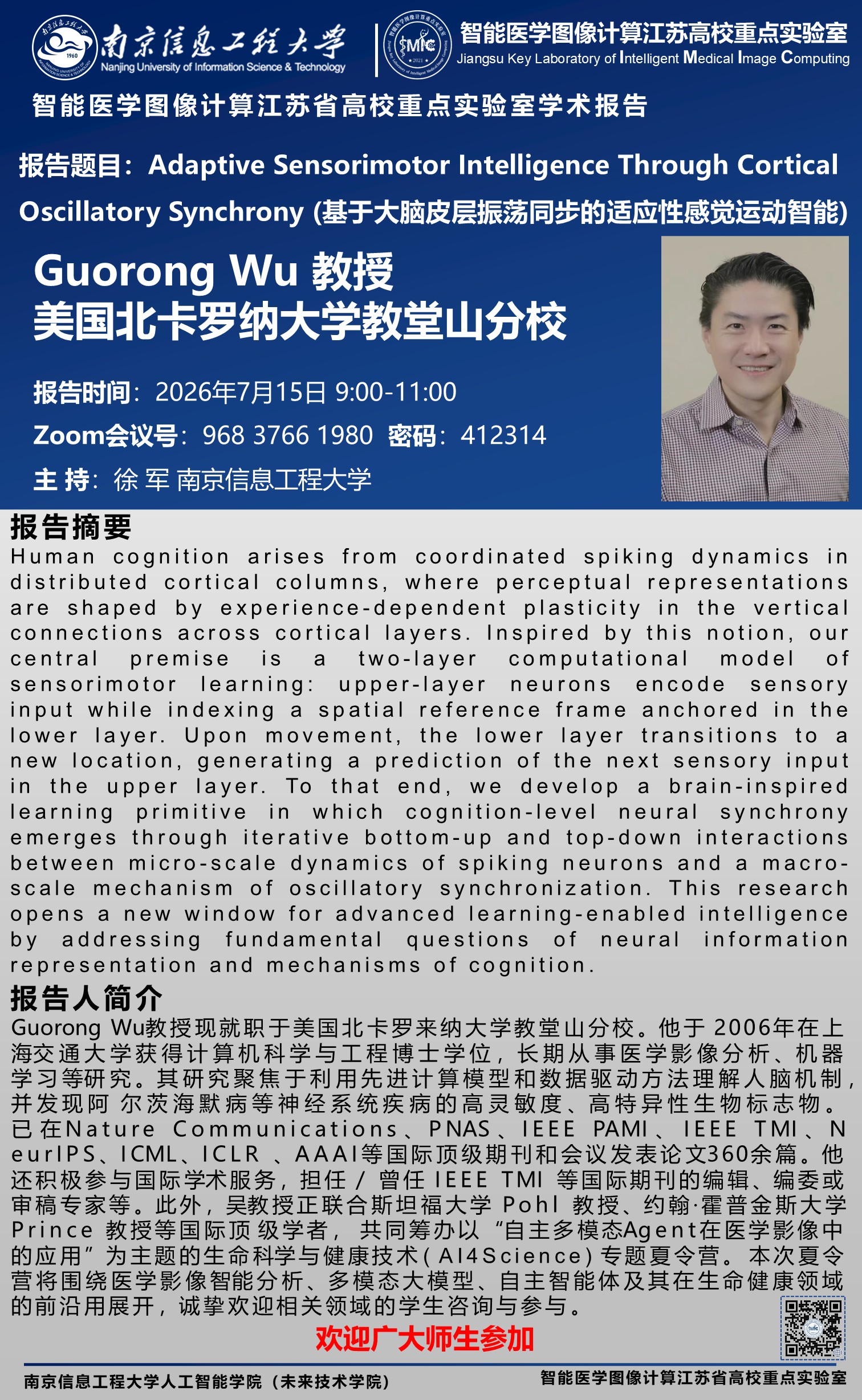
报告题目:Adaptive Sensorimotor Intelligence Through Cortical Oscillatory Synchrony (基于大脑皮层振荡同步的适应性感觉运动智能)
报告人:Guorong Wu 教授
单位:美国北卡罗纳大学教堂山分校
报告时间:2026年7月15日 9:00-11:00
Zoom会议号:968 3766 1980 密码:412314
主持人:徐 军 南京信息工程大学
报告摘要
Human cognition arises from coordinated spiking dynamics in distributed cortical columns, where perceptual representations are shaped by experience-dependent plasticity in the vertical connections across cortical layers. Inspired by this notion, our central premise is a two-layer computational model of sensorimotor learning: upper-layer neurons encode sensory input while indexing a spatial reference frame anchored in the lower layer. Upon movement, the lower layer transitions to a new location, generating a prediction of the next sensory input in the upper layer. To that end, we develop a brain-inspired learning primitive in which cognition-level neural synchrony emerges through iterative bottom-up and top-down interactions between micro-scale dynamics of spiking neurons and a macro-scale mechanism of oscillatory synchronization. This research opens a new window into advanced learning-enabled intelligence by addressing fundamental questions about neural information representation and the mechanisms of cognition.
人类认知源于分布式皮层柱之间协调一致的神经元脉冲放电动力学,其中知觉表征由跨皮层层级垂直连接中的经验依赖性可塑性所塑造。受这一观点启发,我们提出了一种感觉—运动学习的双层计算模型:上层神经元在编码感觉输入的同时,对以下层为锚定的空间参考框架进行索引;当发生运动时,下层会迁移到新的空间位置,并据此生成对上层下一时刻感觉输入的预测。为此,我们构建了一种受脑启发的学习原语(learning primitive),其中认知层面的神经同步通过脉冲神经元微观尺度动力学与振荡同步宏观机制之间反复进行的自底向上和自顶向下交互而涌现。该研究通过探究神经信息表征的基本问题以及认知形成的机制,为迈向更高级的学习赋能智能开辟了新的研究窗口。
报告人简介
Guorong Wu教授现就职于美国北卡罗来纳大学教堂山分校。他于 2006年在上海交通大学获得计算机科学与工程博士学位,长期从事医学影像分析、机器学习等研究。其研究聚焦于利用先进计算模型和数据驱动方法理解人脑机制, 并发现阿 尔茨海默病等神经系统疾病的高灵敏度、高特异性生物标志物。已在Nature Communications、PNAS、IEEE PAMI、IEEE TMI、NeurIPS、ICML、ICLR 、AAAI等国际顶级期刊和会议发表论文360余篇。他还积极参与国际学术服务,担任 / 曾任 IEEE TMI 等国际期刊的编辑、编委或审稿专家等。此外,吴教授正联合斯坦福大学 Pohl 教授、约翰∙霍普金斯大学 Prince 教授等国际顶 级学者,共同筹办以“自主多模态Agent在医学影像中的应用”为主题的生命科学与健康技术 ( AI4Science) 专题夏令营。 本次夏令营将围绕医学影像智能分析、多模态大模型、自主智能体及其在生命健康领域的前沿用展开,诚挚欢迎相关领域的学生咨询与参与 。